Call 1-855-702-7272

Canada’s first child psychiatry access program: Implementation and lessons learned

October 14, 2025
Q2 Compass Newsletter features resources after the Lapu Lapu Festival tragedy, upcoming events, days of remembrance, and the 2024 Provider Satisfaction Survey.
October 14, 2025
We stand with all affected by the Lapu-Lapu Festival tragedy. Resources and support info are available on the newsletter.
Join our first bi-monthly Compass Connections Zoom session on May 22 at 12pm. Drop in to meet a clinician and learn more about Compass services.
May 10 marks the 20th anniversary of Bear Witness Day. Honour Jordan River Anderson by wearing blue, bringing a teddy bear, or sharing his story.
We recognize Thank a Youth Care Worker Week and celebrate those who support youth through challenging times.
Red Dress Day reminds us to honour Missing and Murdered Indigenous Women, Girls, and 2SLGBTQIA+ people. Learn how to take action and support justice.
Take our 2024 Provider Satisfaction Survey to help shape our future work.
Relaunch edition of the Compass Newsletter featuring our services, website, team introductions, and upcoming opportunities in child and youth mental health.
October 14, 2025
We're thrilled to relaunch the Compass Newsletter! In this edition, we're re-introducing ourselves, highlighting our services, showcasing the Compass website, and putting faces to the names you may have encountered during consultations. Future newsletters will be released every quarter and will feature updates on upcoming educational opportunities and valuable mental health insights. In the meantime, remember—we're just a phone call away.
We look forward to connecting with you soon!
Join the Compass virtual lunch and learn on October 1, 2024, to explore the new BC Clinical Care Pathway for Child and Youth Eating Disorders with Dr. Tara Tandan and Dr. Katie Mitchell.
October 14, 2025
BC Children’s Hospital Compass Mental Health program invites you to an upcoming virtual lunch & learn, presented by Dr. Tara Tandan and Dr. Katie Mitchell on the new BC Comprehensive Clinical Care Pathway for C&Y Eating Disorders, which is now live on the Compass Mental Health Website (Pathway Link).
Learning Objective:
Providers will be able to effectively utilize the BC Comprehensive Clinical Care Pathway Tool for Child and Youth Eating Disorders to enhance their care delivery and help with navigation for a patient population who providers may not deliver care to on a regular basis.
When: Tuesday, October 1 2024
Time: 12pm-1pm
Zoom Link (no registration required):
https://phsa.zoom.us/j/64893102750?pwd=scBFexGVOTNkOfTaSXW6i2GaFDeo4a.1
Alternatively, you can join the virtual health visit by entering the following info in Zoom:
Meeting ID: 648 9310 2750
Password: 078190
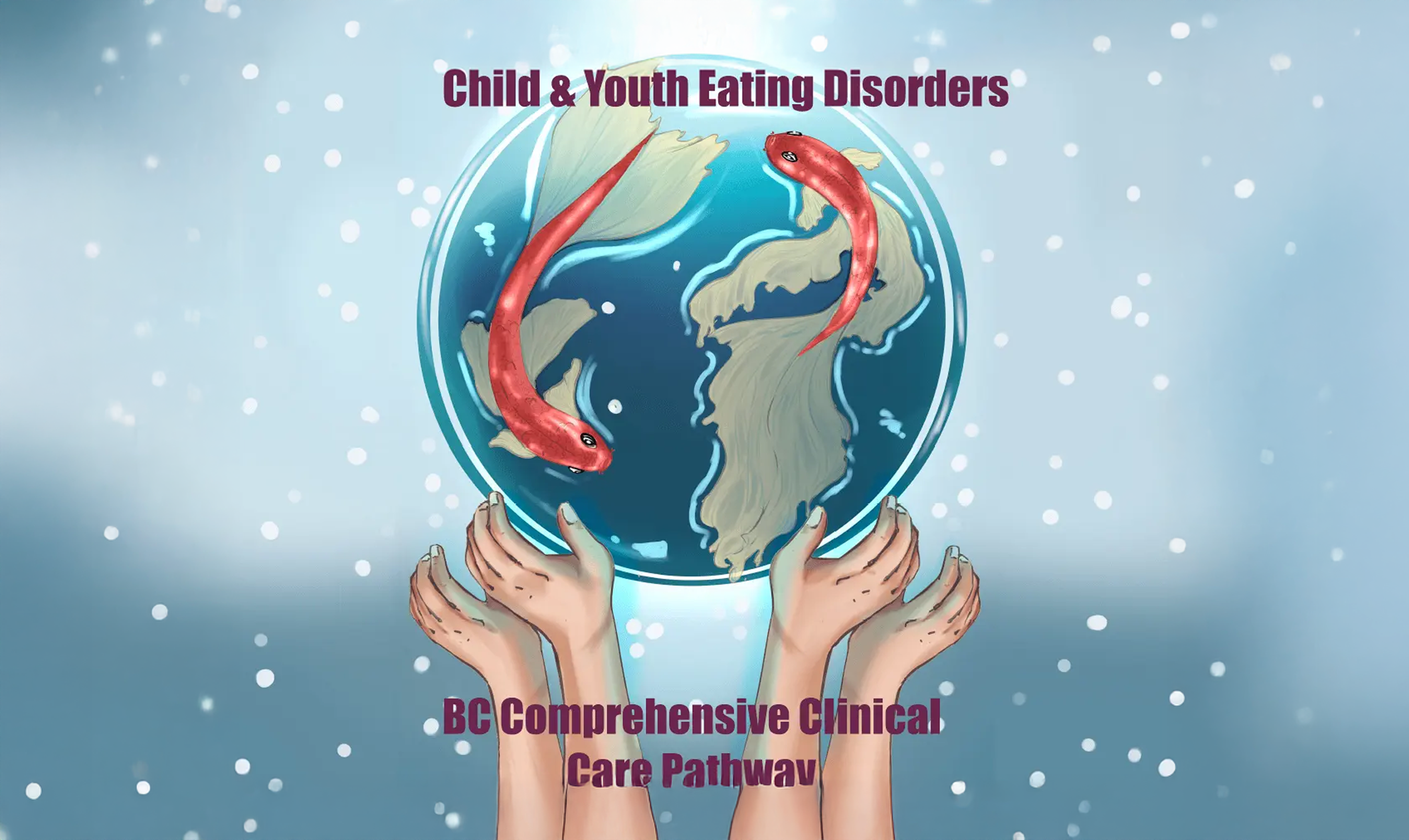
Explore the new BC Comprehensive Clinical Care Pathway for Child and Youth Eating Disorders, offering assessment tools, visit templates, management strategies, and resources to support clinicians across BC.
October 14, 2025
As a result of COVID-19 pandemic impacts, the rates of hospitalization for children and youth (aged 10-17) with an eating disorder in Canada were 1.6 times higher in 2020 when compared to 2019. BC Children’s Hospital, in association with Shared Care (a joint collaborative committee representing a partnership between Doctors of BC and the Government of BC), is pleased to announce the launch of the BC Comprehensive Clinical Care Pathway for Child & Youth Eating Disorders. This pathway tool is aimed at supporting BC clinicians who provide care to children and youth, who may present with possible or confirmed eating disorders.
The pathway tool provides care guidance and navigation for a patient population who providers may not deliver care to on a regular basis, including:
The comprehensive pathway tool is available now under the Resources tab in the Education section on the Compass BC website or can be found at this Link, and will officially launch by the end of summer 2024.

Explore the new Compass Challenging Behaviors and Emotional Dysregulation Toolkit for guidance on assessing and managing complex behaviors with compassionate, trauma informed care.
October 14, 2025
Do you have children or youth in your clinical practice with challenging behaviours and emotional dysregulation? Check out the all NEW Compass Challenging Behaviors and Emotional Dysregulation Toolkit for guidance with assessment and management.
Explore the new toolkit here.
“This toolkit is designed to help clinicians better understand how to approach children and youth presenting with challenging behaviors. Challenging behaviors are often the "tip of the iceberg" and this toolkit guides clinicians in how to assess for underlying environmental, mental health, and developmental factors with the goal of developing a compassionate, trauma-informed management plan that supports both the child and family." -Dr. Susan Baer, Child & Adolescent Psychiatrist

Explore the new Compass Trauma Toolkit for guidance on assessing, screening, and treating trauma in children and youth, with practical tools to support trauma informed care.
October 14, 2025
Do you have children or youth in your clinical practice who have experienced trauma which is impacting their mental health? Check out the all NEW Compass Trauma toolkit for guidance with assessment, screening and treatment.
Explore the new toolkit here.
"This toolkit is designed to help care providers better understand how to engage in trauma-informed care and understand the health impacts of trauma among children and youth. Trauma is a complex but common mental health concern that can affect the emotional and physical wellbeing of children and youth. This Toolkit offers foundational information as well as concrete clinical tools and techniques to help clinicians address trauma-related concerns in their clinical practices." - Dr. Priya Watson, Child & Adolescent Psychiatrist
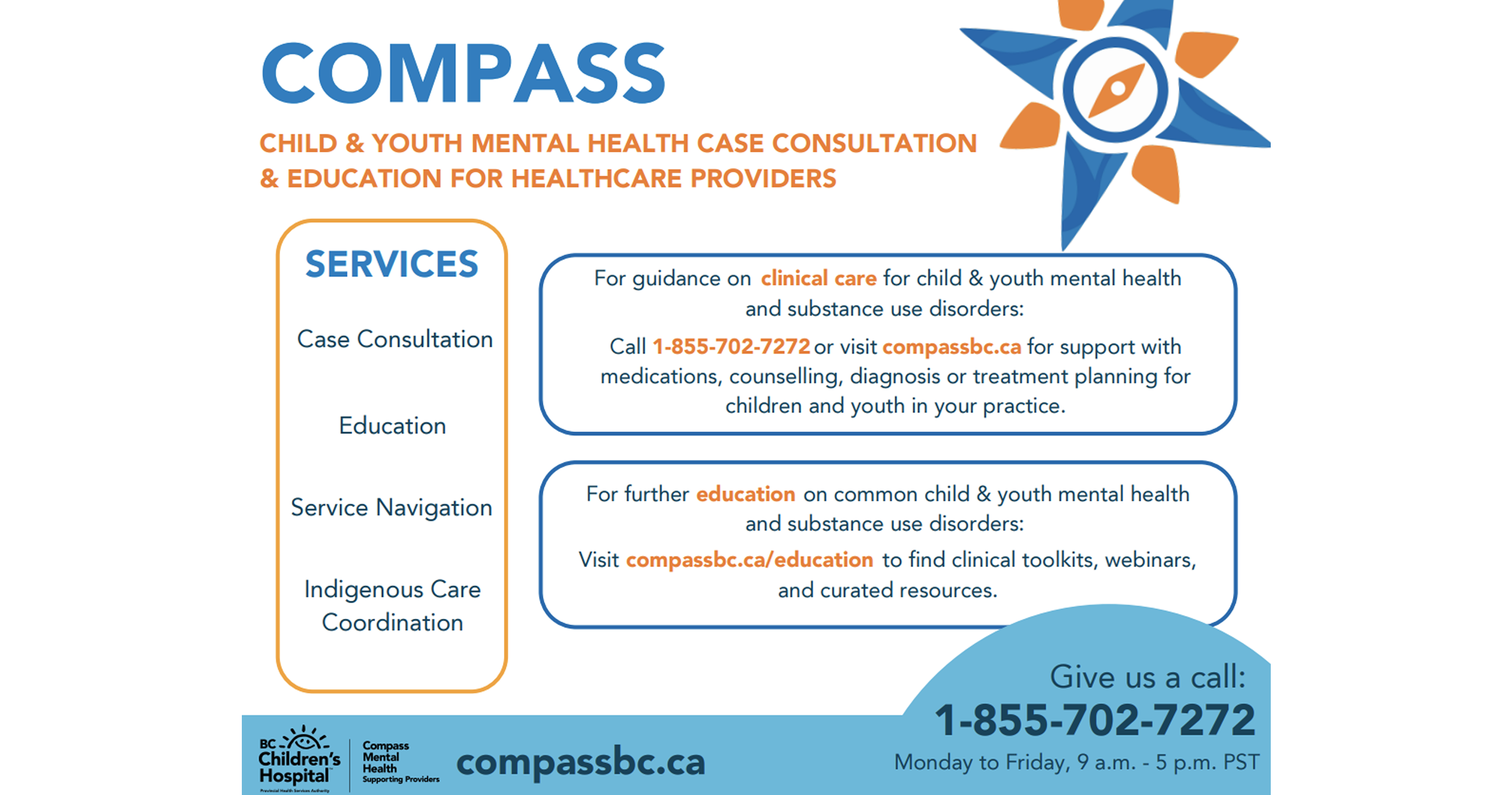
Access Compass more easily with a new one page graphic featuring key program details and contact information, designed for quick reference by your phone or computer.
October 14, 2025
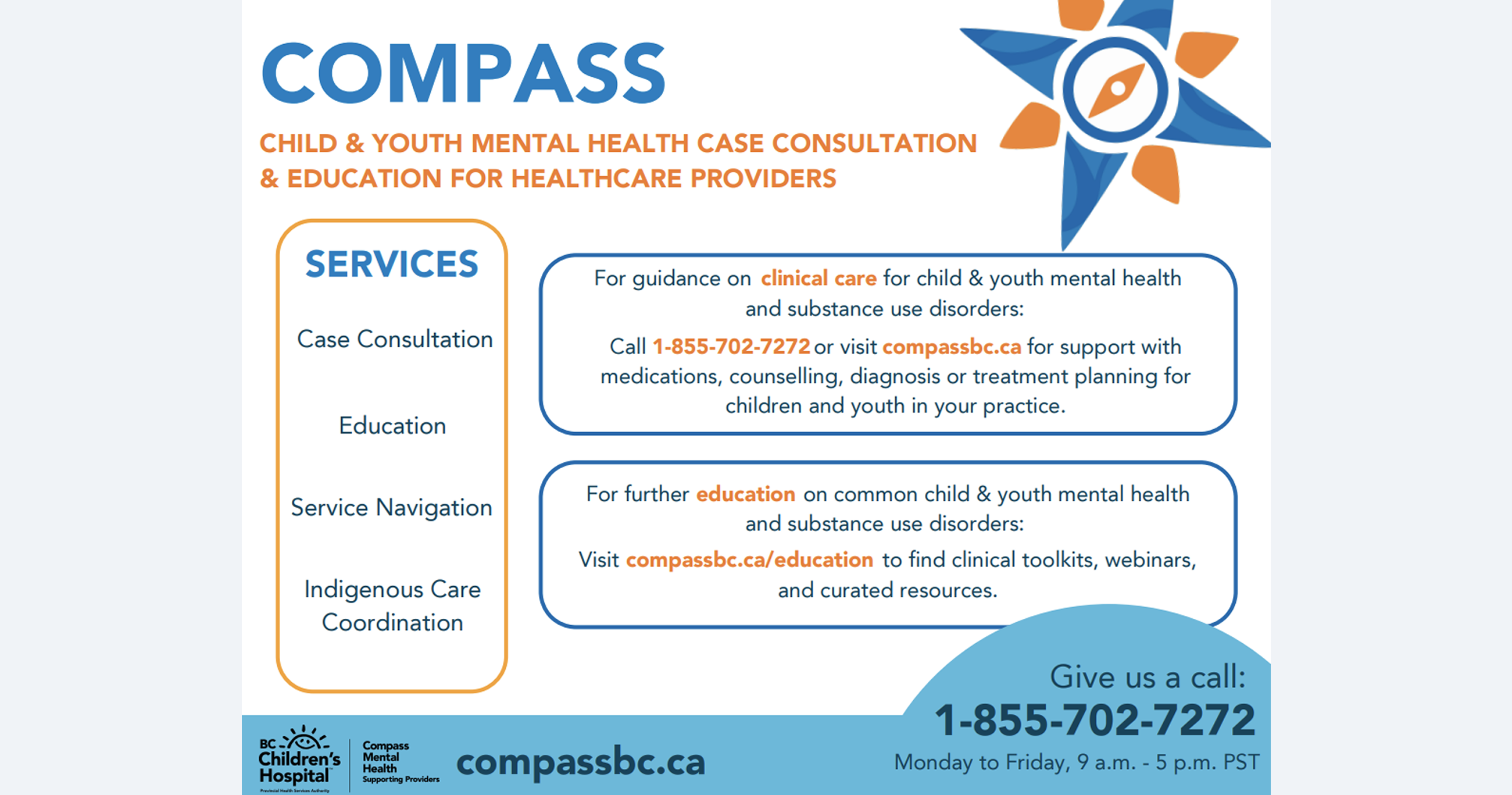
Connecting with the Compass Program just got easier! We're thrilled to present a one-page graphic that simplifies the program's key details and contact information. Designed for ultimate convenience, this printable easy-to-use resource can be placed by your phone or computer, ensuring that providers have essential information at their fingertips.

Follow @KeltyCentre on Twitter for monthly Compass updates on child and youth mental health resources, events, and opportunities to support your practice.
October 14, 2025
Are you on Twitter? Follow @KeltyCentre where you will find a monthly shout out from the Compass program on child & youth mental health resources, events, and opportunities to support your clinical practice.
Discover the new Compass SIB Toolkit with assessment tools and management strategies for self injurious behaviours, plus a related webinar on SIB, autism, and other neurological conditions.
October 14, 2025
Do you have child or youth patients with self-injurious behaviour (SIB)? Do these children and youth also have neurodevelopmental conditions such as autism and intellectual impairment? Check out the all NEW Compass SIB toolkit for assessment tools and management strategies for self-injurious behaviours.
Explore the new toolkit here.
Looking for additional resources on self-injurious behaviour? Check out the Compass webinar on SIB, Autism & Other Neurological Conditions.

Recordings and slides from the Compass webinar series for BC School Counsellors covering anxiety, self injury, depression, and suicide are now available for viewing and download.
October 14, 2025
Compass Team members were so pleased to speak and learn with BC School Counsellors during a recent three-part webinar series. The recordings from the Anxiety in Schools & Self-Injury, Depression & Suicide webinars are now available. The webinar slides are also available to view and print for future reference: Anxiety Slides and Self-Injury, Depression & Suicide slides. Thank you so much to all the school counsellors who joined us.

Recordings and materials from the November–December Compass Connections Webinar Series on Somatization are now available, including session videos, slides, and role play scripts highlighting key clinical strategies and treatment concepts.
October 14, 2025
The recordings from the November-December Compass Connections Webinar Series on Somatization are now available for viewing:
The scripts from the role play scenario is also available. The scripts highlight key clinical strategies to help reduce mistrust and confusion, deliver information about somatization, and introduce two key concepts in treatment - exploring emotions and optimizing functioning.
Thank you to everyone that joined us for this fantastic webinar series!

Explore the new Compass website, your hub for program info, mental health and substance use resources, and upcoming learning opportunities for providers across BC.
October 14, 2025
Welcome to the new Compass website! The new site aims to help providers across BC to better understand the Compass program, access a variety of resources on child and youth mental health and substance use that will be helpful in their practice, and to let you know about upcoming learning opportunities on child and youth mental health. We hope you enjoy exploring our new site!

Support for providers helping children and youth with school attendance challenges. Call Compass for guidance and explore key resources on managing school avoidance.
October 14, 2025
Compass has been receiving many calls from providers supporting children and youth who are experiencing challenges with school attendance. If this is something you are encountering in your practice, feel free to call the Compass line for support and check out the following resources for tips and strategies:

BCCH and UBC are studying how Asian Canadian and White Canadian families make ADHD treatment decisions. Eligible families have a recent ADHD assessment and a child aged 6–18. Physicians receive comorbidity insights and study findings.
November 20, 2025
BCCH-UBC are investigating how Asian Canadian and White Canadian families make decisions about what treatment to pursue for their children and youth with ADHD. The hope is to help reduce the mental health service gap for Asian Canadian families. Each family will complete measures at 3 time points over a year.
Families are eligible for this study if their child/youth:
Referring Physicians Receive:
Find out more about the study and find study resources to share with families here: https://bcchr.ca/adhd-study/study-info-physicians-clinicians
Contact the team for more information:

PsychED4Peds is a child mental health podcast for pediatric clinicians, featuring Dr. Elise Fallucco and other experts sharing practical tools and strategies to support kids and teens.
November 20, 2025
PsychED4Peds is the child mental health podcast designed for pediatric clinicians - helping YOU help KIDS!
Dr. Elise Fallucco, M.D. joins other experts in the fields of child psychiatry, psychology, and pediatrics to share practical, concrete tools, tips, resources and strategies that can help pediatric clinicians take care of kids and teens.
BC Children’s Hospital and Shared Care have launched a new point-of-care pathway to support providers caring for youth with eating disorders, now available on Pathways BC. Clinicians are invited to test it and share feedback.
November 20, 2025
As a result of COVID-19 pandemic impacts, the rates of hospitalization for children and youth (aged 10-17) with an eating disorder in Canada were 1.6 times higher in 2020 when compared to 2019. BC Children’s Hospital, in association with Shared Care (a joint collaborative committee representing a partnership between Doctors of BC and the Government of BC), is pleased to announce the launch of the Clinical Point-of-Care Pathway for Children/Youth with Possible or Confirmed Eating Disorders. This pathway tool is aimed at supporting BC primary care and specialist physicians, and nurse practitioners, who provide care to children and youth, who may present with possible or confirmed eating disorders.
The pathway tool provides point-of-care guidance and care navigation for a patient population who providers may not deliver care to on a regular basis, including:
The new pathway tool is available on the Pathways BC Website, and officially launched on Friday, March 1, 2024. Clinicians will need an account to login to the Pathways BC website, which can be requested free of charge.
In conjunction with this launch, BC Children’s Hospital is seeking feedback from providers who are interested in testing the pathway in their clinical practice, and in providing feedback on its functionality and usefulness in clinical care. All participants will receive honoraria for their involvement in improving this tool. Please find further information here: surveys.reichertandassociates.ca/f/s.aspx?s=FA9EBF09-B89E-4C72-A229-FE2F6D211225
This is one of a number of tools being developed by BC Children’s Hospital to enhance care for children and youth with eating disorders from across BC. We look forward to sharing further updates with you in the months ahead.
Developed with Shared Care/Doctors of BC and UBC CPD, the Child & Youth Substance Use guideline is a concise, practical tool for primary care providers, designed for a 15-minute visit. Explore the new CYSU Clinical Care Pathway here.
November 20, 2025
Formulated in collaboration with Shared Care / Docs of BC and UBC CPD, the Child & Youth Substance Use guideline has been crafted with a principal focus on catering to primary care providers, although its utility extends to other providers. The primary objective of this guideline is to deliver a concise and practical resource tailored for a 15-minute primary care visit, supplemented with links to pertinent resources for further reference.
Explore the new CYSU Clinical Care Pathway here.

A new provincial guideline supports acute care providers in assessing and treating youth ages 10–18.99 experiencing substance intoxication or withdrawal.
November 20, 2025
Child Health BC and BC Children’s Hospital have developed the Provincial Child and Youth Substance Intoxication and Withdrawal Guideline for Acute Care Settings to support providers to deliver standardized, developmentally appropriate, and culturally safe care. The focus of this document is to guide assessment, screening, and initiation of treatment and discharge planning for children and youth ages 10 to 18.99 years old who present to acute care settings with substance intoxication or acute withdrawal symptoms.

The Compass Program supports communities impacted by Northeastern BC wildfires and is committed to ensuring access to child and youth mental health resources during this crisis.
November 20, 2025
We are deeply saddened by impacts of wildfires during this season, particularly the recent example of the devastating wildfires in Northeastern British Columbia. The Compass Program is committed to the well-being and safety of our communities, especially during times of crisis. As the recent disaster and evacuation alerts in the Peace River Regional District highlight, there is urgent need for disaster preparedness and we want to ensure that you have access to the necessary resources for child and youth mental health support during these times.
Red Cross: Guide to Disaster Recovery for Parents & Caregivers
FNHA: Recognizing and Resolving Trauma in Children during Disasters
CMHA: Coping through a natural disaster emergency



PHSA provides specialized health care services to communities across British Columbia, the territories of many distinct First Nations. We are grateful to all the First Nations who have cared for and nurtured this land for all time, including the xʷməθkwəy̓əm (Musqueam), Sḵwx̱wú7mesh Úxwumixw (Squamish), and səlil̓w̓ətaɬ (Tsleil-Waututh) First Nations on whose unceded and ancestral territory our head office is located.
Thanks in part to support from BC Children's Hospital Foundation.
© 2022 Compass Mental Health